
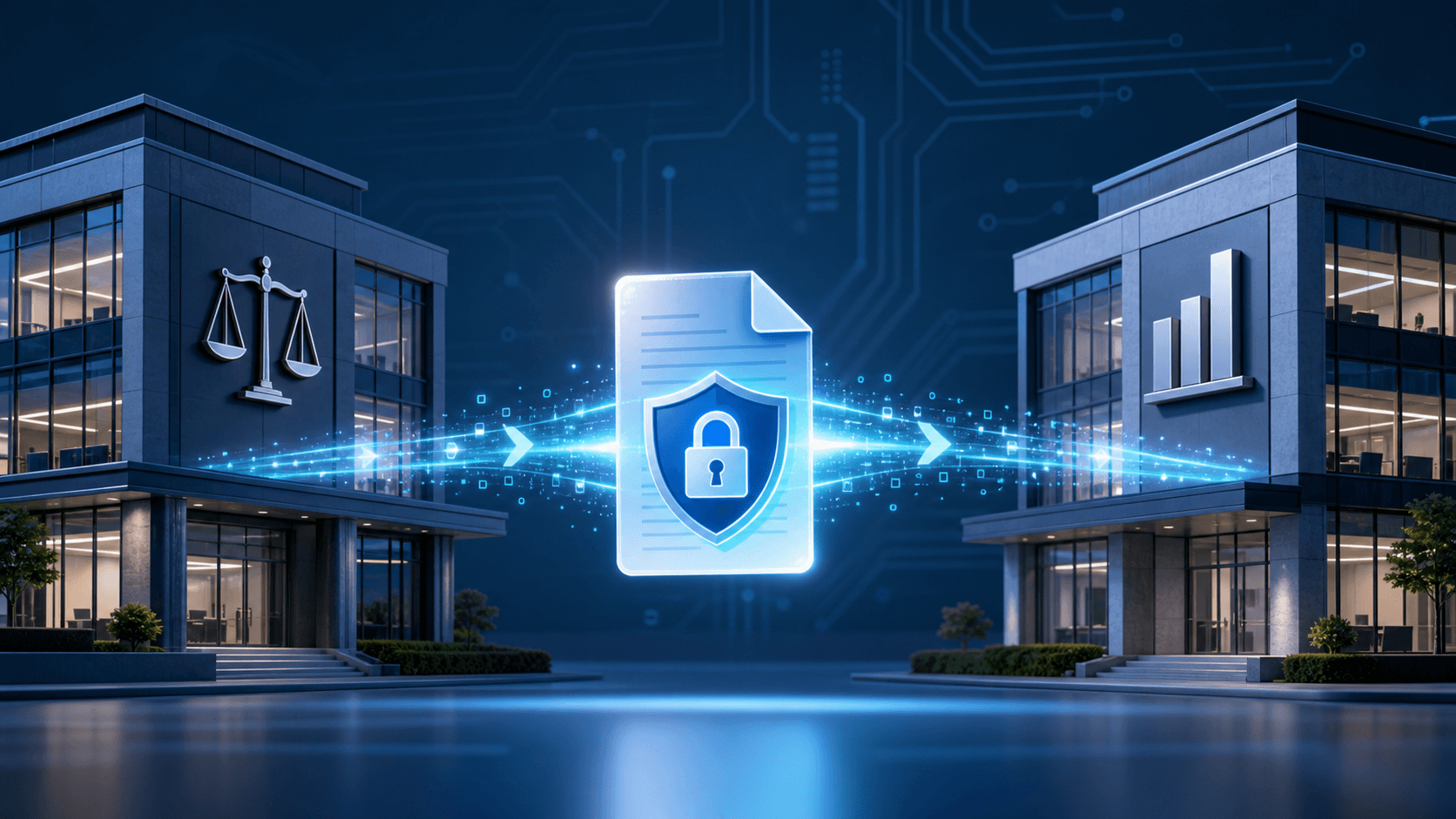
Encrypted file transfer has moved from a nice-to-have into a hard requirement for any law firm or CPA firm that sends and receives personal client files. Your practice handles Social Security numbers, tax returns, bank statements, estate documents, litigation records, and financial disclosures every single day. That data is exactly what attackers want, and regulators now expect you to protect it in motion, not just at rest. If your firm is still relying on standard email attachments or a general-purpose cloud drive to move sensitive documents, you are carrying risk that most partners do not realize they own.
Below we break down where common practices fail, what compliance frameworks actually require, and why we standardize our law and accounting clients on ShareFile and Encyro for secure client document exchange.
The Real Problem With Regular Email Attachments
Email feels convenient, and that is exactly why it is dangerous. A standard message with a PDF attached travels across multiple mail servers, and unless every hop enforces encryption, that file can be intercepted, logged, or stored in plaintext along the way. Even when transport encryption is present, it does nothing once the message lands. The attachment sits unprotected in the recipient inbox, in the Sent folder, in mobile mail caches, and in every forward that follows.
The bigger exposure is human error. Autocomplete sends a client tax packet to the wrong contact. A paralegal forwards a thread that still has a discovery file buried three replies down. An inbox gets compromised through a reused password, and suddenly years of client attachments are sitting in an attacker mailbox. With plain email, you have no recall, no access log, no expiration, and no proof of who opened what. For a firm bound by confidentiality duties, that lack of control is the whole problem.
Why OneDrive, SharePoint, and Google Drive Are Not the Answer Either
Many firms assume that moving to OneDrive, SharePoint, or Google Drive solves the security question. These are strong products for internal collaboration, but they were not built as client-facing secure transfer tools, and using them that way creates predictable gaps.
- Link sprawl and oversharing. The fastest way to share a file is a link, and the fastest link is often “anyone with the link can view.” Those links get forwarded, indexed, and saved. Once created, they are easy to forget and hard to audit across an entire staff.
- Weak external identity. When you share out to a client, you are trusting that the person on the other end is who the link says they are. Consumer accounts, shared family logins, and unmanaged devices sit outside your control.
- Permission drift. Over months, access piles up. Former clients, departed staff, and one-time collaborators retain access that no one revisits until an audit or an incident forces the question.
- No purpose-built client experience. Clients get confused by sign-in walls, tenant restrictions, and access-request prompts. That friction pushes staff right back to email attachments, which is the behavior you were trying to eliminate.
- Compliance ambiguity. Storing regulated data is not the same as governing how it is transmitted and proving it. General drives rarely give you the clean audit trail, expiration controls, and identity verification that regulators and clients expect during an exchange.
The point is not that these platforms are insecure. The point is that consumer-style sharing behavior on top of them is where firms get burned.
What the Regulations Actually Require
Encrypted file transfer is not just best practice. For law and accounting firms, it is increasingly a written obligation.
- CPA and tax firms fall under the FTC Safeguards Rule as financial institutions, which requires encryption of customer information in transit and at rest, along with access controls and monitoring. IRS Publication 4557 further requires tax professionals to maintain a written data security plan and to protect taxpayer data during transmission. The Gramm-Leach-Bliley Act reinforces these duties.
- Law firms are bound by ABA Model Rule 1.6(c), which requires reasonable efforts to prevent unauthorized disclosure of client information, and by a growing body of state bar guidance that treats unsecured transmission of sensitive files as a competence and confidentiality issue.
When a breach happens, the first question an examiner, an insurer, or opposing counsel will ask is how the data was protected in transit. “We emailed it” is not an answer that holds up. A documented encrypted file transfer workflow, with logs, is.
Why We Deploy ShareFile for Our Clients
For firms that need a full client portal and structured document workflows, we standardize on ShareFile. It was built specifically for professional service firms, and that focus shows.
- AES 256-bit encryption at rest and TLS in transit, so files are protected the entire way.
- Branded client portals that make secure upload and download feel like a natural extension of your firm rather than a technical hurdle.
- Granular permissions, expiring links, and multi-factor authentication so access is tightly scoped and time-limited.
- Detailed audit trails and compliance reporting that give you defensible proof of who accessed each file and when.
- Native e-signatures with knowledge-based authentication plus deep integrations with tax and accounting software, which streamlines return delivery, engagement letters, and signatures inside one platform.
For mid-sized and growing practices that want document collection, delivery, signatures, and workflow automation in a single secure system, ShareFile is our workhorse.
Why We Also Use Encyro
Not every exchange needs a full portal, and this is where Encyro shines for our smaller and solo clients. Encyro delivers encrypted email and secure file sharing without forcing your client to create an account, remember a password, or navigate a portal.
- Send encrypted messages and attachments to any email address, with recipients accessing content through a secure, expiring link rather than an exposed attachment.
- No client accounts or shared folders required, which removes the friction that normally pushes people back to plain email.
- Compliance-focused controls that support HIPAA, GLBA, IRS Publication 4557, SOC 2, and GDPR requirements, plus configurable message expiry and audit trails.
- E-signatures with tamper verification that are compatible with IRS forms such as 8879 and 8878.
- Custom firm branding that lets a small practice project the same polish as a large one.
- Affordable, all-inclusive pricing, so security does not become a line item that gets cut.
Encyro gives your team the speed of email with the protection your clients deserve, which is exactly why adoption is so painless.
The Bottom Line for Your Firm
Encrypted file transfer protects three things at once: your clients, your license, and your firm reputation. The cost of a single mishandled tax packet or leaked case file, measured in breach notification, regulatory response, malpractice exposure, and lost trust, dwarfs the cost of doing this correctly from the start. Standard email attachments and consumer-style cloud sharing simply do not give you the encryption, access control, and audit evidence that modern compliance demands.
At SFV Cloud, we design, deploy, and manage secure document exchange for law firms and CPA firms so your team can move files quickly without gambling with client data. If you are ready to replace risky habits with a compliant, client-friendly encrypted file transfer workflow, contact SFV Cloud for a security assessment and a tailored recommendation.
